
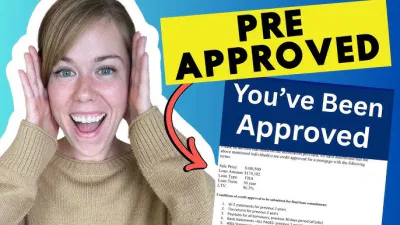
In the digital landscape, we talk about “crawling and indexing” as the first steps to ranking on Google. In the real estate world, the equivalent of being “indexed” is getting your finances verified. If you are serious about buying a home in April 2026, you shouldn’t just be browsing Zillow; you need to know how to get preapproved for a mortgage.
A preapproval is more than just a casual conversation with a bank. It is a formal “audit” of your financial authority. With 2026 interest rates currently averaging 6.34%, sellers are more selective than ever. They aren’t looking for “interested” buyers; they are looking for “verified” buyers.
This guide will walk you through the technical “on-page optimization” of your finances so you can secure a preapproval letter that makes your offer stand out in any “SERP” (Seller’s Evaluation of Relevant Proposals).
1. Prequalification vs. Preapproval: The Technical Difference
Before you dive into how to get preapproved for a mortgage, you must understand the difference between a “prequal” and a “preapproval.”
- Prequalification: Think of this as a “soft signal.” You tell the lender your income and debt, and they give you a rough estimate. It involves no documentation and often no credit pull. It’s a “draft” version of your buying power.
- Preapproval: This is the “published” version. The lender performs a hard credit check and verifies your pay stubs, tax returns, and bank statements. This results in a formal letter that carries real weight with sellers.
If you want to win a bidding war in 2026, you cannot rely on a prequalification. You must know how to get preapproved for a mortgage to prove you have the “backlinks” (financial support) to close the deal.
2. Gather Your “Documentation Assets”
Lenders in 2026 are looking for transparency. To start the process of how to get preapproved for a mortgage, you need to build a “content silo” of your financial life. Most lenders will ask for the following items:
- Income Verification: Your two most recent W-2s and at least 30 days of pay stubs.
- Tax Metadata: Your federal tax returns from the last two years.
- Asset Reports: Two months of bank statements for every account you own.
- Identity Tags: A government-issued photo ID and your Social Security number.
2026 Document Requirements (Table)
| Category | Specific Items Needed | Why it Matters |
|---|---|---|
| Income | W-2s (2 years), Paystubs (30 days) | Proves you have a steady “revenue stream.” |
| Assets | Bank Statements (60 days) | Confirms you have the “capital” for a down payment. |
| Employment | Employer Contact Info | Lenders will “crawl” your job history for stability. |
| Self-Employed | P&L Statement, 1099s | Required for those with “freelance” or business income. |
Export to Sheets
3. The Credit Score Audit (Domain Authority)
Your credit score is the single most important “ranking factor” in how to get preapproved for a mortgage. In 2026, the “prime” tier for the best interest rates usually starts at a score of 760.
When you apply, the lender will perform a “hard pull” on your credit. This might cause a temporary 5-point dip in your score, but it is a necessary part of the “indexing” process. If your score is below 620, you may need to look at specialized FHA products. Understanding your score before you apply is a key part of how to get preapproved for a mortgage.
4. Calculating Your Debt-to-Income (DTI) Ratio
Before a lender gives you a letter, they calculate your DTI. This is the “bounce rate” of your finances—the percentage of your monthly gross income that goes toward paying debts.
The Formula: (Monthly Debt Payments / Monthly Gross Income) x 100.
Most conventional lenders want to see a DTI of 43% or lower. If your DTI is too high, you might need to “de-optimize” (pay off) your car loan or credit cards before you can successfully figure out how to get preapproved for a mortgage for the amount you want.
5. Choosing the Right “Lender Niche”
Not all lenders are created equal. When learning how to get preapproved for a mortgage, you should shop around to at least three different sources:
- Big Banks: Great for “legacy” stability but often have stricter “algorithms” (requirements).
- Credit Unions: Often offer lower rates and a more “humanized” service.
- Online Lenders: The “fastest” way to get a letter, often providing digital approvals in under 24 hours.
Researching multiple lenders allows you to compare APRs and closing costs, ensuring your final “package” is fully optimized for your budget.
6. The 5-Step Preapproval Workflow
Once you have your documents and have chosen a lender, the actual process of how to get preapproved for a mortgage follows a standard workflow:
- Application: You fill out a formal application (often called a Uniform Residential Loan Application).
- Credit Authorization: You give the lender permission to “crawl” your credit history.
- Document Upload: You provide the digital “assets” mentioned in Section 2.
- Underwriter Review: A human or AI “algorithm” reviews your risk level.
- Letter Issuance: If you pass, you receive your preapproval letter.
7. How Long Does a Preapproval Last?
A common question when learning how to get preapproved for a mortgage is the expiration date. In 2026, most preapproval letters are valid for 60 to 90 days.
Because interest rates and your financial situation can change (a “dynamic update”), lenders need to re-verify your data if you don’t find a home within that window. If your letter expires, don’t panic—you usually just need to provide your most recent paystub and bank statement to get a “refresh.”
8. Why Your Preapproval Amount Might Change
Even after you learn how to get preapproved for a mortgage, the number on the letter isn’t set in stone. It can fluctuate based on:
- Property Taxes: A home in a high-tax zip code will reduce your “borrowing power” compared to a low-tax area.
- HOA Fees: Mandatory fees are counted as debt, which can lower your approved loan amount.
- Interest Rate Spikes: If rates jump from 6.34% to 6.8%, your monthly payment increases, which might lower your max loan “ceiling.”
9. Common “Red Flags” to Avoid
While you are in the process of how to get preapproved for a mortgage, you must avoid “unnatural activity” on your accounts. Lenders hate surprises. Avoid:
- Large Deposits: Unexplained cash deposits look like “spam” to an underwriter.
- New Credit Lines: Don’t buy a car or a new sofa until after you close on the house.
- Job Changes: Employment “stability” is a high-weight ranking factor.
10. Using Your Letter to Win the Deal
Once you have mastered how to get preapproved for a mortgage, you have a “verified badge” next to your name. When you submit an offer, your agent will attach this letter. It tells the seller: “This buyer is indexed, verified, and ready to rank.” In a competitive market, a preapproved buyer will almost always beat a buyer who is just “prequalified.”
Preapproval vs. Prequalification Comparison (Table)
| Feature | Prequalification | Preapproval |
|---|---|---|
| Credit Check | Soft (No impact) | Hard (Official) |
| Document Review | None (Self-reported) | Full (Verified) |
| Seller Trust | Low | High |
| Processing Time | Minutes | 1 – 3 Days |
| Validity | Verbal / Informal | Written Letter |
Export to Sheets
Frequently Asked Questions (FAQs)
How to get preapproved for a mortgage with no down payment?
In 2026, you can look for VA loans (for veterans) or USDA loans (for rural properties) which offer 0% down. You still need to go through the full preapproval process to verify your income and credit.
Does getting preapproved hurt my credit score?
Yes, but only slightly. A “hard pull” usually takes about 5 points off your score. However, if you apply with multiple lenders within a 45-day window, FICO treats it as a single inquiry to encourage “shopping around.”
How do I get a mortgage preapproval letter fast?
The fastest way to handle how to get preapproved for a mortgage is to use an online lender with an automated “Plaid” integration. These systems can verify your bank and payroll data instantly, often issuing a letter the same day.
Can I get preapproved if I am self-employed?
Yes! You will just need to provide more “technical documentation,” such as two years of business tax returns and a year-to-date Profit and Loss (P&L) statement.
What is the minimum credit score for 2026 preapproval?
Most conventional lenders look for a 620, while FHA loans can sometimes go as low as 580 with a larger down payment.
Should I get preapproved before or after looking at houses?
Always before. There is no point in “ranking” for homes you can’t afford. Having your preapproval first ensures you only spend time on properties that fit your actual financial algorithm.
Conclusion
Learning how to get preapproved for a mortgage is the most important “technical audit” of your homebuying journey. In the fast-paced market of 2026, you cannot afford to skip this step. By gathering your document assets, auditing your credit score, and choosing the right lender, you set yourself up for a successful “conversion”—the moment you get the keys to your new home.
Don’t treat your preapproval as a chore; treat it as your “Power Level.” It is the document that turns you from a spectator into a player. Now that you know the 5 steps of how to get preapproved for a mortgage, it’s time to reach out to a lender and start the process. Your dream home is waiting, and your preapproval letter is the key that unlocks the door.
Disclaimer: This guide is based on national mortgage standards for April 2026. Individual lender requirements and state laws may vary. Please consult with a licensed mortgage professional for personalized advice.